Heart & Metabolic
Cuff Size Decides Whether A Home Monitor Is Useful
An undersized blood pressure cuff overstates pressure and an oversized one understates it, making cuff fit the largest single source of error in home readings.

Home blood pressure monitoring is now routine, and most devices sold are accurate enough. The reading is frequently wrong anyway, and the cuff is usually the reason.
How the measurement depends on the cuff
An oscillometric monitor inflates the cuff until flow stops, then reads pressure oscillations in the artery as the cuff deflates and converts them into numbers.
That conversion assumes the cuff bladder encircles a defined proportion of the arm, so pressure applied at the surface reflects pressure inside the artery.
When the bladder is too short for the arm, more pressure is needed to compress the artery, and the device reports that inflated requirement as the blood pressure.
The direction of the error is predictable
A cuff too small for the arm overestimates, and the overestimate grows with the mismatch, which can be enough to move someone into a treatment category.
A cuff too large underestimates, which is the less commonly discussed error but produces the more dangerous outcome of hypertension left untreated.
Because the error is systematic rather than random, averaging more readings does not fix it. Every measurement is wrong in the same direction by a similar amount.
Fitting is done by measuring the arm
Cuff size is determined by upper arm circumference, measured at the midpoint between shoulder and elbow, not by a person's height, weight or clothing size.
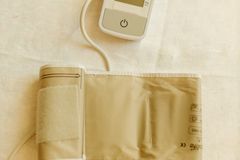
Cuffs carry printed range markings and index lines showing whether the wrapped cuff falls within the acceptable window for that particular arm.
Many monitors ship with a single average cuff, and larger or smaller sizes usually have to be bought separately for the same device.
Other setup errors compound the problem
Placing the cuff over a sleeve, leaving the arm unsupported, crossing the legs, a full bladder or talking during measurement each shift readings measurably.
Arm position relative to the heart matters as well, since a cuff sitting below heart level adds hydrostatic pressure to the reading.
Wrist monitors are more sensitive to position than upper arm devices, which is why clinicians generally prefer the latter for people managing hypertension.
Validating the device against the clinic
Bringing the monitor and its own cuff to an appointment allows a side-by-side comparison against the office measurement.
Agreement within a few points suggests the home setup is sound, and a persistent gap points to cuff fit or technique rather than a defective machine.
That comparison is worth repeating occasionally, since cuffs stretch, bladders leak slowly and arm circumference changes across years.
Also by Ray Okafor
- Why muscle, not weight, is the number that matters after 60Strength & Mobility
- The balance test you can do in your kitchen, and what to do if you fail itStrength & Mobility
- Grip strength is the cheapest health test in medicineStrength & Mobility
- Can you get up off the floor without using your hands?Strength & Mobility