Strength & Mobility
Can you get up off the floor without using your hands?
It sounds like a party trick. It is a composite test of leg strength, hip mobility, balance and coordination — and the ability to reverse a fall is what determines whether a fall becomes a catastrophe.
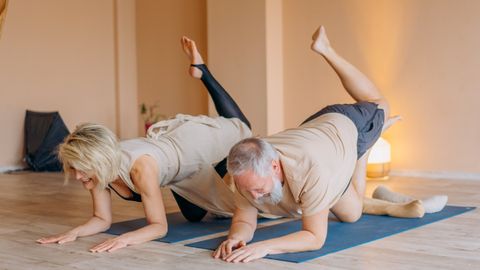
The sitting-rising test was popularised by Brazilian physician Claudio Gil Araújo, who published a study in 2012 following more than two thousand adults aged 51 to 80. Participants were asked to lower themselves to the floor and stand back up, starting with a score of ten and losing a point for each hand, knee, forearm or side of the leg used for support, plus half a point for visible loss of balance.
Those scoring three or below had a mortality rate roughly five to six times higher over the follow-up period than those scoring eight or above. The association held after adjusting for age, sex and body mass index.
As with grip strength, the interesting question is not whether the correlation is real — it clearly is — but what the test is standing in for.
Why this particular movement
Getting off the floor without hands requires several capacities simultaneously, and failing any one of them produces a low score.
It requires hip and ankle mobility sufficient to fold into a deep position. It requires single-leg strength, because at some point in the ascent your weight sits over one leg. It requires balance through a large range of motion, not just standing still. It requires coordination to sequence the movement. And it requires enough relative strength — strength in proportion to bodyweight — that the whole thing is possible at all, which is why the score correlates with body composition.
Most conventional fitness measures capture one of these. Walking captures almost none of them. It is entirely possible to walk five kilometres daily and score four out of ten.
Clear a space, work on a rug rather than tile, and have a chair within reach the first time. Cross your legs, lower yourself down without support, then reverse it. Count each point of contact used. Do not attempt it unsupervised if you have had a hip or knee replacement, or if you are already unsteady — the test is not worth an injury, and a physiotherapist can assess the same capacities more safely.
The reason it matters more than the mortality statistic
Set aside the survival curves. There is a more immediate reason to care about this, and it is about what happens after a fall rather than before one.
Falls in older adults are common, and most do not cause serious injury on impact. What causes serious harm is the long lie — remaining on the floor unable to get up, sometimes for hours. Long lies are associated with dehydration, hypothermia, pressure injury, rhabdomyolysis, pneumonia and a sharply worse prognosis than the fall itself would predict. Studies of emergency ambulance calls for fallers find that a substantial fraction of those who are on the floor for more than an hour die within six months.
A person who can get off the floor has had an embarrassing afternoon. A person who cannot has had a medical emergency. The physical difference between those two outcomes is often quite small, and it is trainable.
Training the pattern
The capacity responds to practice remarkably well, because much of what is lost is skill and mobility rather than raw strength. Most people over sixty simply have not been on the floor deliberately in years, and the pattern has decayed from disuse rather than decline.
Work backwards through the levels:
- Sit to stand from a chair, no hands. Ten repetitions. Lower the chair height as it gets easier — a lower surface is a longer range of motion and more demand on the hip.
- Kneeling to standing. From a half-kneeling position — one knee down, one foot forward — stand up. Use a chair for balance at first, then a fingertip, then nothing. This is the crucial transition and the one most people cannot do.
- Floor to kneeling. Getting from sitting on the floor onto one knee. Roll to the side, push up to a hand-and-knee position, bring one foot forward.
- The whole sequence, hands allowed, then with one hand, then with none.
Ten minutes, two or three times a week. Progress is usually visible within a month, which makes it one of the more rewarding things to train.
The supporting work
Two limitations show up repeatedly and need addressing directly.
The first is ankle dorsiflexion — how far the knee can travel forward over the foot. Restricted ankles make deep positions impossible and force compensations elsewhere. Calf stretching against a wall, and loaded work through a full range, both help.
The second is single-leg strength. Split squats, step-ups onto a low box, and lunges from a supported position all build the specific capacity required. Bilateral leg press does not transfer nearly as well, because the demand for stability is absent.
If you cannot do it at all
That is worth taking seriously, and it is not a reason for embarrassment — it is common, and it is the group with the most to gain.
Two things are worth doing straight away. Learn a backward chaining technique for getting up after a fall, which occupational therapists teach and which uses furniture in a specific sequence; it works even where unaided rising does not. And consider a personal alarm, which is unglamorous and removes the long lie from the list of possible outcomes entirely.
Then start on step one. A person who cannot get off the floor today and can in four months has changed something real about how the next decade is likely to go.
Also by Ray Okafor
- Why muscle, not weight, is the number that matters after 60Strength & Mobility
- The balance test you can do in your kitchen, and what to do if you fail itStrength & Mobility
- Grip strength is the cheapest health test in medicineStrength & Mobility
- Aerobic fitness after 60: what VO2 max means and why it keeps fallingHeart & Metabolic