Strength & Mobility
Kyphosis, posture and what can actually be changed
Some age-related forward curvature is structural and permanent. A meaningful share is postural and muscular, and telling the two apart determines whether exercise will help.
Thoracic kyphosis — the forward curve of the upper back — is normal, typically 20 to 45 degrees in healthy adults. It increases with age in almost everyone, and in a proportion becomes pronounced enough to affect function.
The consequences are not only cosmetic. Increased kyphosis is associated with reduced pulmonary function, because chest expansion is mechanically limited. It shifts the centre of mass forward, which increases falls risk and alters gait. It reduces the ability to look up and ahead. It correlates with difficulty in reaching, with reduced physical function scores, and in several cohort studies with mortality.
What causes it, and the crucial distinction
Vertebral compression fractures are the major structural cause. Each anterior wedge fracture tips the spine forward by a few degrees, permanently. Several accumulate into a visible change. This component cannot be reversed by exercise, because the bone has changed shape.
Disc degeneration — anterior disc height loss produces similar wedging without fracture.
Muscular and postural factors — weakness of the spinal extensors, habitual forward posture, and shortening of the anterior chest muscles. This component is modifiable.
The practical test is simple: lie flat on your back on a firm surface, or stand against a wall, and see whether the curve reduces. A curve that flattens substantially when the postural component is removed has a large modifiable element. A curve that remains fixed is largely structural.
The occiput-to-wall distance. Stand with heels, buttocks and shoulder blades against a wall and try to touch the back of your head to it without lifting your chin. Any measurable gap suggests increased kyphosis; a gap of several centimetres is significant and, in an older adult, is associated with a higher likelihood of an undiagnosed vertebral fracture.
Why undiagnosed fractures matter here
Vertebral compression fractures are the commonest osteoporotic fracture and the most often missed. Roughly two-thirds are never clinically diagnosed, because they occur without significant trauma and the back pain is attributed to something ordinary.
They are important to find. A prevalent vertebral fracture substantially increases the risk of a subsequent fracture, including hip fracture, and it is a clear indication for osteoporosis treatment.
Which means new or progressive kyphosis, height loss of more than about 4 cm from young adult height, or a significant occiput-to-wall distance, should prompt assessment for osteoporosis rather than being treated as a posture problem.
What exercise achieves
Trials of spinal extensor strengthening in older adults with hyperkyphosis show modest improvements in curve angle — typically a few degrees — and larger improvements in physical function, balance and self-rated appearance. A few degrees may sound trivial and matters more than it sounds, because the relationship between curve angle and forward displacement of the centre of mass is amplified over the length of the spine.
Mary Bouxsein and Wendy Katzman's work on kyphosis-specific exercise programmes has been among the more careful in this area, and reports improvements in kyphosis and in physical performance measures.
The programme components:
- Thoracic extensor strengthening. Prone lifts — lying face down, lifting the head and chest a small distance — and resisted rows. The extensors are typically weak and are the direct antagonist to the curve.
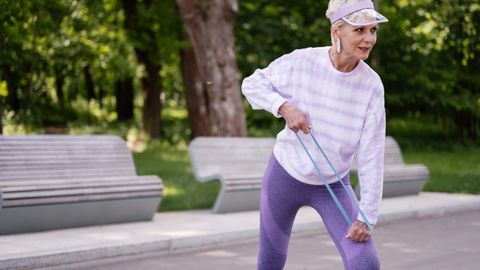
- Scapular retraction work. Band pull-aparts, rows, wall angels.
- Anterior chest and shoulder mobility. Doorway stretches, and lying over a rolled towel placed lengthways along the spine.
- Thoracic extension mobility. Extending over a foam roller placed across the upper back, within comfort.
- Postural awareness training, which has surprisingly good short-term effects and poor retention without the strength work underneath it.
Three sessions a week, sustained. As with everything else in this field, it fades when it stops.
The exercise to avoid
Anyone with osteoporosis or known vertebral fractures should avoid loaded spinal flexion — sit-ups, crunches, toe-touching with a rounded back, and loaded forward bending. A frequently cited study of women with osteoporosis found a substantially higher rate of new vertebral fractures in those doing flexion exercises compared with extension exercises.
Twisting under load is also best avoided. This rules out a fair number of standard gym exercises and mainstream Pilates and yoga movements, so it is worth telling any instructor about a diagnosis rather than assuming a class will be appropriate.
Bracing, and its limits
Spinal orthoses and posture-training supports have some evidence for reducing pain and improving posture in the short term in people with vertebral fractures. Their role is limited and they are not a long-term solution — prolonged bracing risks weakening the very muscles that need strengthening.
The realistic expectation
Someone with several wedge fractures will not become straight. What they can achieve is meaningful: better balance, better breathing mechanics, less pain, a slower rate of progression, and a few degrees of the postural component recovered.
And the underlying priority for that person is not the posture at all. It is bone protection, so that the next fracture — and the next several degrees — does not happen.
Also by Ray Okafor
- Why muscle, not weight, is the number that matters after 60Strength & Mobility
- The balance test you can do in your kitchen, and what to do if you fail itStrength & Mobility
- Grip strength is the cheapest health test in medicineStrength & Mobility
- Can you get up off the floor without using your hands?Strength & Mobility