Strength & Mobility
Starting strength training at 70: the first twelve weeks
Nobody needs a gym membership, and the biggest mistake is not going too heavy — it is going too light for too long and concluding that it does not work.
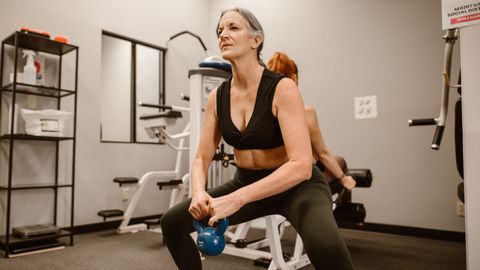
The evidence that resistance training works in the eighth and ninth decades is thirty years old and unusually consistent. What is missing for most people is not motivation but a starting point that does not assume prior knowledge.
Here is one. Two sessions a week, six movements, forty minutes including rest, at home with almost no equipment.
The six movements
Every functional demand in daily life reduces to a handful of patterns. Cover these and you have covered the body.
1. Sit-to-stand. From a dining chair, arms crossed. This is the squat pattern, and it is the single most functionally important exercise on the list. Progress by using a lower chair, holding a weight against your chest, or slowing the descent to a count of three.
2. Step-up. Onto the bottom stair or a low box. Lead with one leg, stand fully, control the way down. This is your single-leg strength and it is what determines whether you can get off the floor.
3. Hip hinge. Feet hip-width, soft knees, push the hips back while keeping the back flat, hands sliding down the thighs. Add a weight held in both hands as it becomes easy. This trains the posterior chain, which is the most neglected area and the one most involved in preventing a forward fall.
4. Row. A resistance band anchored in a door, or a weight in one hand supported on a chair. Pull the elbow back past your ribs. Counteracts the forward-rounded posture that develops with age and is the main upper-body pulling pattern.
5. Push. Press-ups against a wall, progressing to a kitchen counter, then a low bench. Or an overhead press with light dumbbells if the shoulder allows.
6. Carry. Pick up two heavy shopping bags and walk. Trains grip, trunk stability and the exact task that fails first in real life.
Use the reps-in-reserve idea. At the end of a set you should feel you could manage two or three more repetitions and no more. If you could do ten more, it is not training — it is movement. Aim for 8–12 repetitions per set, two to three sets per exercise. When you can comfortably exceed 12, increase the load.
Weeks one to four: learning the movements
Bodyweight or very light load. The goal is not to get stronger; it is to learn the patterns and let connective tissue begin adapting. Tendon and ligament adapt more slowly than muscle, and the injuries that derail beginners nearly always come from load rising faster than tissue tolerance.
Two sessions a week, one or two sets of each exercise, well short of failure. Expect some muscle soreness for two or three days after the first sessions. It reduces sharply after the first fortnight and is not a sign of damage.
Weeks five to eight: adding load
Now add resistance and start progressing. Two to three sets, 8–12 repetitions, reaching that two-to-three-reps-in-reserve point on the last set.
Equipment worth owning at this stage: a set of resistance bands, and either adjustable dumbbells or a few fixed pairs. Total cost is modest. Bands are excellent for upper body and awkward for legs, because legs are strong and bands top out.
Most of the gains in these first weeks are neurological — the nervous system learning to recruit more motor units — rather than actual muscle growth. Strength rises faster than size, and it rises fast. A doubling of what you can lift over eight weeks is not unusual and is not evidence that the numbers were wrong at the start.
Weeks nine to twelve: making it a habit
By now the movements are familiar and load is climbing. This is the point at which most programmes stop and most people revert, so it is worth being deliberate about what happens next.
Add a third session if you want, or keep two and increase the load. Consider adding a power element — standing up from the chair as fast as you safely can for a few repetitions — because power declines faster than strength with age and matters more for catching a stumble.
The mistakes that matter
Too light for too long. By far the commonest. Three-kilogram dumbbells for a year produce very little. The load has to become genuinely difficult and then increase.
Too much too soon. The opposite error, less common but more disruptive. Progress load by around 5 to 10 per cent at a time.
Machines only. Fixed machines remove the stability demand, which is a large part of what you are training for.
Skipping the legs. Upper body work is more comfortable and less useful.
Stopping when something hurts, rather than modifying. A painful shoulder does not stop you training legs. An arthritic knee tolerates partial-range work.
When to get help first
Speak to your doctor before starting if you have unstable angina, uncontrolled hypertension, symptomatic aortic stenosis, a recent cardiac event, or an acute injury. For nearly everyone else, the risk of resistance training is lower than the risk of continuing not to do it — and cardiac rehabilitation programmes routinely include resistance work in patients considerably less well than the average reader of this article.
If you can, spend two or three sessions with a physiotherapist or a coach experienced with older adults. Learning the hip hinge properly once is worth more than a year of guessing at it.
Also by Ray Okafor
- Why muscle, not weight, is the number that matters after 60Strength & Mobility
- The balance test you can do in your kitchen, and what to do if you fail itStrength & Mobility
- Grip strength is the cheapest health test in medicineStrength & Mobility
- Can you get up off the floor without using your hands?Strength & Mobility