Strength & Mobility
Tai chi has better falls evidence than most things sold as exercise
It looks gentle enough to seem unserious. In randomised trials it reduces falls by a margin comparable to intensive balance programmes, and the reason is structural rather than mystical.
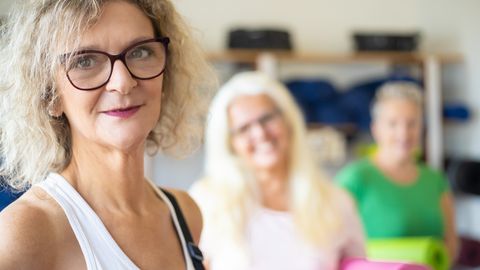
Tai chi is one of the more thoroughly studied exercise interventions in older adults, largely because it is cheap, safe, well tolerated and easy to deliver in groups — which makes it attractive to trialists and to health systems alike.
The results have been consistently good. Cochrane's review of exercise for falls prevention identifies tai chi as one of the intervention types with clear evidence, and individual trials have reported reductions in fall rate of a third or more in community-dwelling older adults. A 2018 trial comparing a tai chi programme specifically designed for falls prevention against conventional exercise and stretching found the tai chi group had significantly fewer falls than either comparator.
Why it works, without any mysticism
The mechanism is entirely explicable in terms of what the activity actually involves, and it maps neatly onto the components of a good balance programme.
Continuous weight transfer. Almost every movement shifts the centre of mass from one foot to the other, slowly and under control. That is precisely the challenge that falls-prevention programmes are designed around, and tai chi delivers it for an hour without anyone calling it an exercise.
Reduced base of support. Many postures involve standing predominantly on one leg, or with the feet close together.
Movement through a large range at the hip and ankle, maintaining the mobility that stride length depends on.
Sustained semi-squat position, which loads the quadriceps isometrically for an extended period — considerably more demanding than it looks, as anyone who has done an hour of it will confirm.
Trunk rotation and head turning while maintaining balance, which trains the vestibular system in exactly the situations that provoke instability in daily life.
Dual-tasking. Remembering a sequence while moving loads attention simultaneously, which is the condition under which most real falls occur.
Most trials used Yang style or purpose-designed programmes such as Tai Ji Quan: Moving for Better Balance. Effective doses in trials were typically two to three sessions a week for at least 12–24 weeks. Shorter courses show smaller effects. As with all balance training, the adaptation fades within weeks of stopping.
What it does not do
Honesty is worth more than enthusiasm here.
Tai chi does not build significant muscle strength. The loads are low and do not increase. Someone with meaningful sarcopenia needs resistance training as well; tai chi will improve their balance and not their strength.
It does not develop cardiorespiratory fitness to any great extent. Most styles sit at a light intensity — enough to count toward general activity guidelines, not enough to change VO2 max.
Claims about tai chi for hypertension, arthritis, fibromyalgia, cognition and depression exist in the literature with varying quality. Some are reasonable, several rest on small unblinded trials with attention-control problems. The falls and balance evidence is much stronger than the rest of it, and it is worth recommending on that basis rather than as a general remedy.
Why people stick with it
Adherence is where tai chi outperforms almost everything else, and adherence is what determines whether an exercise intervention works in the real world rather than in a trial.
Several features contribute. It is social and typically delivered in a group. It is low-impact and does not hurt. There is no equipment, no changing room and no lycra. Progress is measured in the smoothness of a form rather than in a number, which suits people who dislike competitive framing. And it can be done in a village hall, which is where a great many older adults actually are.
Drop-out rates in tai chi trials are consistently lower than in comparable exercise trials. That is not a small consideration for an intervention whose benefits disappear when it stops.
Getting started
Look for classes explicitly aimed at older adults or at falls prevention — several health systems and falls services commission them directly, and community centres, leisure centres and some GP practices can point you to one.
Ask whether the instructor has experience with older participants and with adapting for limitations. Many forms can be done seated or with a chair for support, which makes it accessible to people who cannot stand unsupported.
Give it three months. The first few weeks feel like learning choreography rather than exercising, and the balance gains accrue quietly underneath that.
The sensible combination
If you were designing a week for an older adult from the evidence, it would look roughly like this: two resistance sessions for strength and muscle mass, one or two tai chi or balance sessions for stability, and daily walking for cardiovascular health and mood.
Tai chi is not a complete programme. It is, for the specific problem of falling over, one of the better-supported components of one.
Also by Ray Okafor
- Why muscle, not weight, is the number that matters after 60Strength & Mobility
- The balance test you can do in your kitchen, and what to do if you fail itStrength & Mobility
- Grip strength is the cheapest health test in medicineStrength & Mobility
- Can you get up off the floor without using your hands?Strength & Mobility